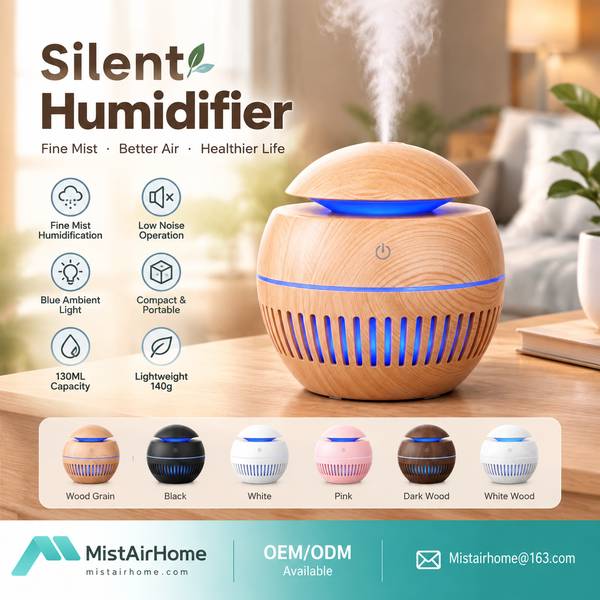
 High-Power Outdoor Cooling Fan — Brushless Turbo Technology. MistAirHome Direct Manufacturer.
Customer Service Hotline:
+8613261677119
High-Power Outdoor Cooling Fan — Brushless Turbo Technology. MistAirHome Direct Manufacturer.+8613261677119

TL;DR - The Mistairhome WL-QH07U (PLUS) holds 1020 mL and mists 100 mL per hour or 46.0 mL per hour, which is 10.2 hours and 22.2 hours per fill; it covers 26 sq m (283 sq ft) at a 2.6 m ceiling and measures 27.3 dB on the high step and 24.9 dB on the sleep step; it draws 5.6 W and runs from USB-C 5V/2A; no internal cell on this build; it weighs 775 g and measures 14.6 x 14.6 x 25.4 cm, and ships documented to CE / RoHS / FCC standards for import into United Arab Emirates. MOQ is 200 units per SKU with a 25-35-day lead time, FOB Shenzhen or EXW Longgang.
China Wanlin supplies the Noise Free Bedroom Humidifier category as a direct manufacturer, not as a trading intermediary. The unit described below is one configuration out of 24 combinations (8 chassis x 3 SKU builds) that share a common misting family, a common tank and seal line and a common documentation set, so a distributor can build a coherent shelf from one source rather than stitching together unrelated suppliers. Every unit referenced on this page corresponds to a specific bill of materials held on file, so the figures below can be reproduced or independently verified at sample stage.
Full specification of WL-QH07U-PLUS:
| Misting method | Ultrasonic piezo disc at 1.7 MHz under closed-loop humidity control |
| Tank capacity | 1020 mL |
| Mist output on the high step | 100 mL per hour |
| Mist output on the low step | 46.0 mL per hour |
| Run time per fill on the high step | 10.2 hours |
| Run time per fill on the low step | 22.2 hours |
| Coverage area | 26 sq m (283 sq ft) at a 2.6 m ceiling |
| Noise at 1 m on the high step | 27.3 dB |
| Noise at 1 m on the sleep step | 24.9 dB |
| Water type | Tap or distilled; the tank opens at the top and reaches a hand at the bottom |
| Mineral dust handling | Cartridge bay plus a silver ion ring in the tank on the Pro build |
| Fill method | Top fill with a removable lid and a wide brush opening |
| Battery pack | Not fitted, runs from the USB-C supply |
| Cordless run time | Not applicable, mains or USB powered |
| Charge time | Not applicable, no internal cell |
| Power input | USB-C 5V/2A |
| Rated power on the high step | 5.6 W |
| Control interface | Capacitive panel with target humidity, three mist steps, timer and child lock |
| Night light | Seven-colour ring plus a white reading mode, both switchable off |
| Protection | Dry-run shut-off, tilt switch, sensor fault alert, overcurrent limit |
| Dimensions | 14.6 x 14.6 x 25.4 cm |
| Weight | 775 g |
| Warranty | 24 months |
Shipping configuration: Plus build, + hard carry case + wick and cartridge starter set + gift box + funnel. Master carton holds 12 units. Stated lead time is 25-35 days from order confirmation and deposit. Misting discs, wicks and cartridges are repeat line items and are ordered separately from the appliance.
Three things move this category in United Arab Emirates: heated or cooled air that dries a room faster than people expect, buildings sealed tightly enough that nothing replaces the moisture, and a cleaning task that decides whether the product is still in use by March. Channel structure follows a stable pattern: importers take container volumes, regional distributors break bulk into pharmacy, hospitality and facilities supply, and online sellers absorb the mixed-SKU remainder that suits catalogue breadth.
For the Noise Free Bedroom Humidifier segment the deciding specifications are the noise figure at the step people sleep on, the run time per fill, and what the unit does with dissolved minerals. Peak mist volume ranks below all three, which surprises first-time buyers. This is why the table above states figures by model rather than by marketing tier: a buyer comparing two SKUs needs the noise on the sleep step, the run time per fill and the water handling side by side, because those three predict both satisfaction and return rates better than any other set.
Wanlin serves United Arab Emirates through three programmes that suit different balance sheets. New partners start with sample evaluation then a mixed trial order. Established distributors move to scheduled container shipments with locked pricing windows. Brand owners run private-label programmes with their own artwork and manuals. In all three cases the factory documentation, including the certificates and battery files listed further down this page, references the specific model code on the order rather than a generic family certificate, which is the most common cause of customs delay in this category. The WL-QH07U (PLUS) packs 12 units to a carton, carries a 24 months warranty and a 25-35 days stated lead time, and draws 5.6 W on the high step.
Three engineering decisions separate this platform from the commodity end of the category. The first is how quiet is stated. A decibel figure without a distance, a room and a step is not a specification, so we publish the conditions next to the number: measured at one metre in a semi-anechoic corner, and quoted separately for the high step and the sleep step. The sleep-step figure is the one that belongs in a tender document, because it is the step an occupant actually leaves the unit on all night.
The second is where the noise comes from, because that decides how far it can be pushed down. Three sources remain once the fan is removed: the disc drive frequency, the turbulence at the outlet, and the structure-borne path into whatever the unit stands on. The first is handled by driving the disc below its resonant peak, the second by a low-turbulence outlet grille, and the third by a floating silicone isolator - which is why a unit reads measurably louder on a hollow bedside table than on a carpet, and why we quote the distance rather than letting a buyer assume.
The third is the trade that nobody states. Quieter costs output: a disc driven below resonance moves less water, and a restricted outlet moves less air. Rather than hide that, we publish both steps and let the buyer decide which one the room needs. On the WL-QH07U (PLUS) the figures worth carrying into the next order are the 1020 mL tank, the 22.2 hours per fill on the low step, and the 24.9 dB reading on the sleep step.
Three deployment records from the Noise Free Bedroom Humidifier programme, each with the conditions that shaped it. Site detail is kept because it is the part that transfers: the water, the ceiling, the rota and the complaint are what decide whether a unit stays in service, and none of them appear on a specification sheet.
Deployment: A private hospital refurbishing 40 single rooms
Timing: Twelve months from June 2025
Single rooms made this a per-room purchase rather than a central one, and infection control asked how long a tank could stand full without use. The honest answer is that standing water grows biofilm, so we specified a wide opening and a weekly dry-out in the maintenance note. The hospital's own audit at month six found the routine being followed, which is more than most suppliers could claim.
Deployment: A hospital supply distributor covering central Vietnam
Timing: Sixteen months from May 2025
The distributor serves both hospital and retail channels, and the documentation requirements differ between them. Certificates issued per model code rather than per family let the same container serve both channels without a second test round, which is a practical advantage that shows up in the landed cost rather than in the unit price.
Deployment: A sleep clinic running eight overnight study rooms beside a busy arterial road
Timing: Nine months from March 2025
The clinic's constraint was a measurement one: the polysomnography microphones pick up anything above roughly 30 dB, so a quiet claim on a spec sheet meant nothing. We shipped samples first and let the technicians run them in an empty room with the recording gear live. The sleep-step figure, not the high-step figure, was what got the order, and the clinic now specifies the sleep-step number in its own purchasing document.
The pattern across all three is that the deciding factor was never peak output. It was whether the tank lasted a full shift, whether the unit could be cleaned inside the time a round allows, and whether anyone complained about the noise or the dust. Those are the questions we ask before quoting. The WL-QH07U (PLUS) packs 12 units to a carton, carries a 24 months warranty and a 25-35 days stated lead time, and draws 5.6 W on the high step.
Four placement patterns cover most of the enquiries we see for this category. The useful observation is that each one is answered by configuration and placement rather than by buying a larger unit, which is the default reflex and usually the wrong one.
| Scenario | Room or site | What the site needs | What the unit does |
| SC03-WORKSTATION | Individual desks on an open-plan floor served by mechanical ventilation | A corridor or ceiling-mounted unit cannot reach a desk when the supply diffuser is moving air. | One compact unit per desk cluster sits inside the two-metre radius where the plume is still airborne, which is a placement answer rather than an output answer. |
| SC01-NURSERY | Night feeds and settled sleep in a room shared with an infant | Nothing should wake a sleeping infant, and no lamp should be on when the room is dark. | The sleep step holds output low all night while the chassis stays under the ambient level of a quiet bedroom, and the night light can be switched off entirely rather than merely dimmed. |
| SC09-TANKRUN | Rooms with nobody responsible for refilling, and buildings on a weekly maintenance round | Refilling decides whether an appliance survives in a managed building more than performance does. | A large tank holding a night plus a working day on the low step, with a humidistat so the unit runs only when the room actually needs it. |
| SC07-WARD | Post-operative and long-stay wards where the supply air is filtered and the parts list matters | Whatever goes into the air has to be declarable, which rules out heated and additive-based systems. | Cool mist leaves the water composition unchanged, the material declaration covers every wetted part, and the evaporative build holds minerals in the wick rather than releasing them. |
Two of these four are decided before the unit is switched on: whether the tank lasts the interval the site can actually service, and whether the cleaning task fits the round. For this configuration that means 46.0 mL per hour at 24.9 dB, holding 22.2 hours per fill across a 26 sq m (283 sq ft) room.
The practical advantage of a factory programme is flexibility in how the first order is shaped, not the unit price. A mixed container across three SKUs lets a distributor test a range without committing to full container quantities on unproven models, which is the single biggest risk reduction available to a new importer and one that intermediaries rarely offer because it complicates their own purchasing.
The second advantage is lead-time honesty. A stated lead time of 15 to 35 days measured from order confirmation and deposit, written on the proforma invoice rather than left open, is worth more to a buyer planning a season than a faster number that slips. Battery shipments add a documentation step at booking, which we handle but which needs a few extra days on the freight side, and we say so before the order rather than after.
The third is continuity. Tooling, mouldings and the documentation set stay the same across seasons, so a distributor who lists a model code this year can relist it next year without a new test round. On the WL-QH07U (PLUS) the figures worth carrying into the next order are the 1020 mL tank, the 22.2 hours per fill on the low step, and the 24.9 dB reading on the sleep step.
Four documentation errors account for most of the customs delay we are asked to fix, and all four are avoidable at quotation stage. The first is a certificate naming a family rather than the model code on the invoice. The second is a battery build shipped without UN38.3 and MSDS. The third is a manual in the wrong language for the destination. The fourth is a plug that does not match the destination.
None of those are engineering problems. They are paperwork problems, and they are the reason we ask three questions before quoting: which markets, which languages on the manual and the artwork, and whether any unit in the order carries a cell. Answering those three costs a buyer five minutes and removes the majority of the delay risk.
What we will not do is back-date a certificate or issue one against a model we did not build. A buyer who needs that is a buyer whose shipment will be stopped eventually, and the cost of the test is always smaller than the cost of the container sitting at the port. The WL-QH07U (PLUS) packs 12 units to a carton, carries a 24 months warranty and a 25-35 days stated lead time, and draws 5.6 W on the high step.
The economics of this line are an annuity, not a one-off sale, and buyers who plan it that way outperform the ones who do not. The appliance is the entry; the cartridge, the wick and the replacement disc are the repeat, and in the pharmacy and hospitality channels the consumable revenue overtakes the appliance revenue within the first year.
Freight is the part that needs doing carefully. At 0.083 cubic metres per carton of 12 units, a 40 ft container carries roughly 6,768 units by volume, and a 20 ft about 3,072. Those are upper bounds before pallet and loading losses, and the honest planning figure is a little below them.
What we suggest to a first-time buyer is deliberately unglamorous: a mixed trial order across two or three SKUs, spares at one disc per twenty units, a stated lead time of 25-35 days written on the proforma invoice, and a re-order point set by sell-through rather than by calendar. On the WL-QH07U (PLUS) the figures worth carrying into the next order are the 1020 mL tank, the 22.2 hours per fill on the low step, and the 24.9 dB reading on the sleep step.
What order size does Wanlin accept for a first quiet humidifier shipment?
200 units per SKU on standard builds, 300 where a custom colour or private-label packaging is involved, and several models may share one container provided each SKU clears its own minimum. For a buyer testing the category for the first time, a mixed container is the lower-risk route and is the one we recommend over a single-SKU container on an unproven model.
How loud is the unit in practice, and which figure should a buyer compare?
Compare the sleep-step figure, not the headline one. WL-QH07U is rated 24.9 dB on the sleep step and 27.3 dB on the high step, both measured at one metre under stated conditions. In a bedroom the high step is rarely used, so the number that predicts whether the unit stays plugged in is the lower one.
Will an ultrasonic quiet humidifier put mineral dust on dark furniture?
On hard water, yes, unless the build deals with it. The disc atomises the water and everything dissolved in it, and the minerals settle as a white film. For WL-QH07U-PLUS the answer built into the specification is cartridge bay plus a silver ion ring in the tank on the pro build. Where neither option is acceptable to a buyer, the evaporative chassis removes the question entirely because the water never becomes airborne.
What documentation comes with a quiet humidifier shipment for customs?
CE technical file, RoHS and REACH declarations, an EMC report and the IEC 60335-1 appliance safety report as standard, plus UN38.3, IEC 62133 and MSDS on any build carrying a cell, and FCC for the digitally controlled models going to North America. Every document names WL-QH07U rather than a family, which is what a customs officer checks.
Is private label available across the quiet humidifier range?
Across the whole range, including housing colour, logo, retail artwork, manual language and the accessory kit. Most of it works inside existing tooling, so it does not add engineering time. What it does add is a decision about consumables, and we raise that early because the cartridge choice affects the return rate more than any artwork decision does.
What is the cleaning routine, and how much staff time does it take?
Five to seven days in continuous use, with a dry-out before any period of storage. The routine takes under two minutes on this chassis because the tank opening is wide enough for a hand and a brush, which is deliberate. A narrow-neck tank takes longer, gets cleaned less often, and eventually gets replaced - which is the real cost of a cheap moulding.
What happens if a unit fails inside the warranty period?
24 months on WL-QH07U against manufacturing defect. In practice most failures outside the warranty period are a worn disc or a scaled cartridge rather than a faulty appliance, which is why we stock both as separate lines and ship them with the units. A distributor who can supply the part keeps the customer.
What is the timeline from sample approval to a shipped container?
From approved sample to a shipped container, 25-35 days for first production plus the freight booking step, which is longer on battery builds because of the cell documentation. Sampling itself is 5 to 7 working days on an existing specification. We put the production figure on the proforma invoice so it is a commitment rather than an estimate.
Five kinds of partner buy this programme, and they want different things from it. Importers want container economics and documentation they can hand to a broker without rewriting. Regional distributors want a range coherent enough to explain on one page, and a spares line they can actually stock.
Brand owners want the artwork and the manuals right and the chassis underneath unchanged, which is the easiest request we handle because most of it sits inside existing tooling. Pharmacy and home-care groups want the consumable, because the repeat revenue is there rather than in the appliance. Cross-border sellers want prep: barcodes, multilingual manuals and packaging that survives a fulfilment centre.
Export traders sit across all five, and the thing they ask for most often is a specification sheet they can forward without editing, because their customer will ask about noise, run time and water before asking about price. On the WL-QH07U (PLUS) the figures worth carrying into the next order are the 1020 mL tank, the 22.2 hours per fill on the low step, and the 24.9 dB reading on the sleep step.
The cleanest first orders we see share one habit: the buyer declares the destination list at quotation stage. Certificates, manuals and plugs all follow from it, and raising them once as a package costs far less than raising them market by market as each order lands.
After that the sequence is ordinary. Sample evaluation first, on the actual specification rather than a similar one, with the buyer measuring mist output by a weighed run, run time per fill at the low step, and noise at one metre in a quiet room. Then the proforma invoice, which carries the stated lead time and the packing list rather than leaving them open. Then production, then booking.
The one step buyers skip and regret is the spares decision. Adding a spare disc per twenty units and a cartridge per unit where the water is hard costs almost nothing on a first container and prevents the top-up shipment that otherwise arrives in the middle of the season. On the WL-QH07U (PLUS) the figures worth carrying into the next order are the 1020 mL tank, the 22.2 hours per fill on the low step, and the 24.9 dB reading on the sleep step.
The right way to evaluate this unit is to order a sample on this specification and measure it: mist output by a weighed run, run time per fill at the low step, and noise at one metre in a quiet room on both steps. All three are reproducible, and a buyer who runs them will know more in an afternoon than any datasheet can convey.
We publish figures that can be checked, we state the ceiling height behind the coverage number, and we say plainly where the honest answer depends on the room or the water. That is a narrower claim than some competitors make, and it is the one we can stand behind at sample stage.
Export enquiries are welcome from distributors, brand owners, pharmacy and home-care groups, hospitality operators, cross-border sellers and export traders. Samples, specification sheets and the certification and battery files are available on request. For this configuration that means 46.0 mL per hour at 24.9 dB, holding 22.2 hours per fill across a 26 sq m (283 sq ft) room.
Published by: Wanlin Manufacturing Group, MistAirHome Export Division
Published on: September 28, 2026
Data sources: in-house factory testing + misting disc and cell specifications + certification and battery files + partner deployment records
Company address: Wanlin Group, Building B, Building 1, Beisida Medical Device Building, 28 Nantong Avenue, Baolong Community, Baolong Sub-district, Longgang District, Shenzhen, Guangdong, China
References: factory quality manual + third-party test reports + customer shipment records
Contact: Mistairhome@163.com / +8613261677119 / https://www.mistairhome.com